Wednesday, March 19, 2014

Frozen and Theology of the Body: The Gospel According to Disney


*Warning: this post contains major spoilers to the movie Frozen, so if you have not seen it yet, go see it, then come back and read this*

When I first saw the trailer for the movie Frozen, I was not particularly interested in seeing it. My sister and I shared this view, and discussed how The Snow Queen was one of our favorite fairy tales as children, and from the trailer we could see that Frozen was a huge departure from the original story. The first trailer I saw was also only a short (which is not even in the film) about Olaf and Sven racing to get Olaf’s carrot nose, which has fallen off on the ice. It all just seemed a little ridiculous and silly to me. 

An image of the trailer I originally saw
 
But then, I started hearing rave reviews about it from my friends from grad school, and I started hearing some of the songs that were blowing up on Youtube; so I decided perhaps I did want to see it after all. Fast forward to February, when I finally got around to actually seeing it, and subsequently had my mind blown by the sheer awesomeness of the film.

This semester, I also happen to be taking a class on John Paul II’s Theology of the Body, and I could not help but notice some amazing parallels in Frozen, although it took several weeks of pondering to fully work them out into something coherent enough to post in a blog. I have read a few other posts about how Olaf represents Original Man and his original innocence, or about the theme of agape love in the film, but nothing quite like what was going on in my mind when I watched it.

I’m sure none of this was intentional by Disney, but why not use it for the glory of God?

Let’s start with Elsa. 


In the beginning...
Elsa represents humanity in general. We see her “in the beginning” completely happy with her powers (her “gift”), using it for creativity and fun, and enhancing her close relationship with her sister, Anna. In my interpretation, Anna represents God or, more specifically, Christ. So, “in the beginning” Elsa and Anna have a close relationship (just like humanity had with God in the Garden of Eden “in the beginning”), and Elsa sees the beauty of her own identity and gift/power. Her gift represents that gift that we all have as human beings – our gift of self, which is expressed in a particular way through our sexuality.

According to John Paul II, our sexuality means the fact that our bodies are sexed, that is, either male or female, and that this aspect of our bodies is meant to show us that we are created for self-donation. In other words, we are called to give ourselves to another. In marriage, a man is called to give himself to his wife (and vice versa), and the body becomes the way in which he gives himself to her, not just physically, but totally – his whole self, body and soul.

However, this potential for self-gift, particularly in the context of sexual activity, but also in the context of any human relationship in which there is love and sharing of self, also carries within it a potential to hurt others or be hurt by another.

In Frozen, this concept is expressed by the Troll King, who tells Elsa about her power “there is beauty in it, but also great danger.” It is significant that he tells her this right after she has injured her sister, Anna, with her power. We can see this as an analogy to humanity’s broken relationship with God through Original Sin. Instead of trusting God, Adam and Eve “injure” him by breaking his trust and eating the forbidden fruit, which leads to them being ashamed and afraid of him. When God comes looking for them, they hide, much like Elsa is hidden away from Anna because she and her parents are afraid she will hurt her again. Obviously, there are a lot of factors in the Genesis story that do not line up perfectly with the plot in Frozen, but this is a basic analogy between the two.

The Troll King also tells Elsa “you must learn to control [your power]; fear will be your enemy.” This is essentially what Christ tells us about our passions – we must learn self-control and attain self-mastery to avoid hurting ourselves and others, but we must also “not be afraid,” since fear is an enemy that keeps us from making a true self-gift, which always involves vulnerability.

However, Elsa’s well-meaning parents mistakenly interpret the Troll King’s words, and tell her “conceal it; don’t feel it.” This is not the same as self-control and self-mastery, which allows us to rightly order our passions towards the good, but is actually a suppression of the true self with all its feelings. Because Elsa is forced to try to suppress her gift out of fear, she ends up struggling more, becoming more isolated (even from her parents), and she has even less control of her powers. 
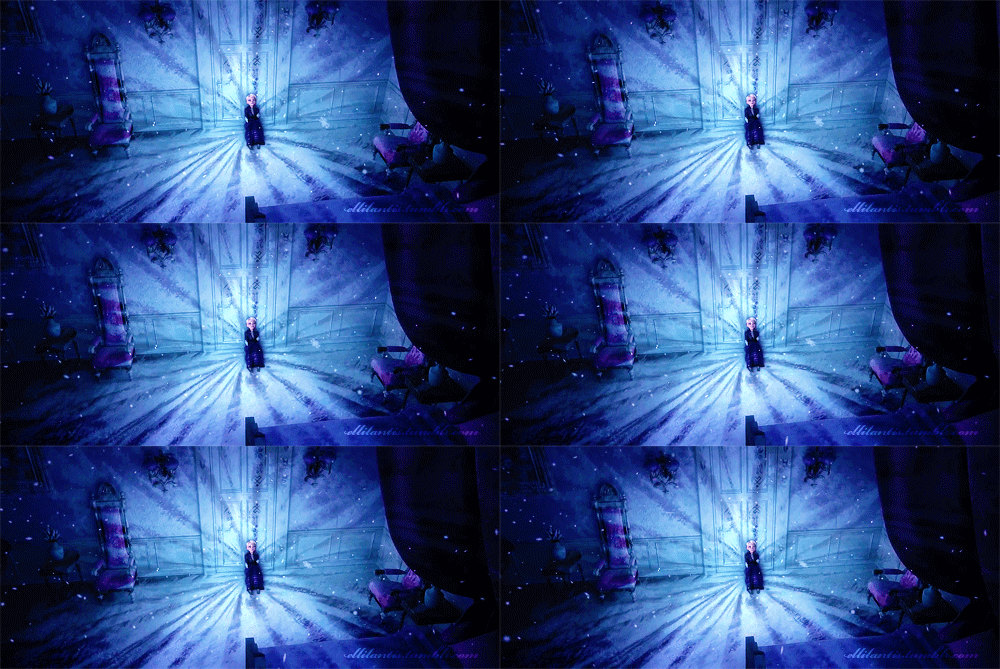
  
I compare this particularly to sexuality, because it is such an easy analogy, and something that so many people struggle with. Like Elsa, when we try to suppress our sexuality, instead of learning true control, those urges often come out in times of intense emotion (particularly negative emotion), and can manifest as sin. Part of this is because of a denial of the goodness of the gift of sexuality, and failure to act in a way that respects that goodness. Instead, the true goodness is overlooked and the potential danger becomes the focus. In Elsa’s case, this is a denial of the goodness of her gift/power, which is seen only as dangerous and something to be feared because it has the potential to harm others or us, much like our sexuality does when not used properly.

Elsa's powers when she is afraid
When Elsa is ultimately put in a stressful situation, we see her lose control of her power. When she finally does “let go” without fear of hurting others (she thinks), we see that the power she has is creative, beautiful, and even life-giving. When she reacts out of fear, her power manifests in a way that pushes others away – all the icicles, etc. are jagged and threatening to others. But when she is removed from the place of fear, the snow and ice is smooth, beautiful, and she even creates new life in Olaf the snowman. However, she still has the isolation mentality, and does not share her creative gift with others out of fear of how people will perceive her. 

This is similar to how sin isolates us, but also how our sin affects the community (the Church, the Mystical Body of Christ). Elsa thinks that her power is only affecting her, now that she is isolated on the mountain, meanwhile the snowstorm she created is still affecting those she left behind in her kingdom. This is why we, as Catholics, go to a priest for confession, because as part of the Church (the mystical Body of Christ), we are all connected, and even our personal sins affect others in ways we may not be able to see, much like Elsa could not see how her powers were affecting others. Once alone on the mountain, Elsa believes that she is free and fully herself. Although we do see a glimpse of this in the beautiful and life-creating manifestation of her powers, we also see how deep inside, she is trapped by the same fear, which imprisons her in “a kingdom of isolation.”
Here we also see how Elsa's powers start to turn in against her, so it is not just keeping people out, but keeping her trapped inside alone, much like our sin does to us
True freedom leads to self-control, not simply suppression, and is guided by love, not fear since “perfect love casts out all fear” (1 John 4:18). Similarly, it leads to communion, not isolation. When Anna tries to convince Elsa to come down the mountain with her, we see this invitation to communion and redemption. In their reprise of the song “For the First Time in Forever,” Elsa insists that although she is alone, she is “alone and free” and tells Anna “just stay away and you’ll be safe from me.” Anna recognizes that Elsa is not truly free, since she is isolated by her fear, telling her “for the first time in forever, we can fix this hand in hand…you don’t have to live in fear, because…I will be right here.” However, Elsa rejects Anna’s offer because she does not believe she can “reverse the storm” she’s made.

This is one of my favorite parts of the movie, not only because the song is amazing, but because it says so much about how we often react to Christ when we are in sin. Like Elsa, we often mistakenly think that our sins are too great to overcome, even with help – and even with help from Christ himself! Like Anna, Christ invites us to “face this thing together” and “make the sun shine bright” by reversing the storm made by our sins.

Now here’s the best part…

Elsa’s rejection of Anna’s offer of help and freedom can be likened to our rejection of Christ. Like Anna’s heart, which is pierced by Elsa’s ice, Christ’s heart is pierced by our rejection of him. This rejection is most dramatically seen in his passion and death on the cross, in which his heart is literally pierced by the centurion’s spear, but more so by people rejecting his love. Like Christ, Elsa’s rejection of Anna pierces her heart and she dies because of this rejection. 


 However, also like Christ, Anna dies to save Elsa – an act of true, sacrificial love as a complete self-gift for the good of the other. This act of love leads to Anna’s “resurrection,” which shows Elsa the true meaning of love and enables her to submit her power (her “gift”) to that love, which frees her from her prison of fear, and reunites her with her community. This can be compared to how Christ offers us the gift of his grace and the gift of redemption, which he accomplishes through his sacrifice of love on the cross. This gift of redeeming love and grace enables us to attain self-mastery, and use our gift of self (and our sexuality in particular) to bring about communion and life. Elsa’s power, when under the control of love, leads her to communion with her sister and her kingdom, so she is no longer isolated, and is able to use her gift to bring joy to others.

Anna shows Elsa what true love is – “love is putting someone else’s needs before yours” and “some people are worth melting for” (Olaf). Similarly, Christ shows us that we are worth dying for, and it is his sacrifice of love on the cross that not only teaches us how to love, but gives us the love and redeeming grace that enables us to live a life of love. The love that Christ offers us leads us to true freedom and self-mastery, as well as to communion with himself, the Church, and others (our neighbors) so that we are freed from fear and isolation, and our gift of self becomes life-giving.


Sunday, March 2, 2014

The Beauty of Presence

I started writing this post after I had been living at home with my parents in California for about four months. Their house is very full - both of my sisters are at home, and my grandparents (my father's parents) live with them in their own separate apartment downstairs. This was always the plan when my parents bought our house over 16 years ago. No, they didn't plan on having three adult children at home, but they bought the house with my grandparents in mind. They moved in with us 7 years ago, and it has been a blessing having them home with us. We always lived within 3 miles of them, so having them close was nothing new, and I instantly loved being able to just walk downstairs to visit with them, and share in my grandmother's traditional Portuguese cooking.

My grandparents enjoying each others' company before her dementia worsened

However, in the last couple of years, my grandmother's health has deteriorated, and she now struggles with the daily cross of dementia/Alzheimer's. Although it has been a blessing having her in the same house where my father and our family can help care for her, it has also been a great cross and trial for him, his brother (who lives nearby and often comes over to help as well), and the rest of our household. My grandmother often thinks that she is back in Portugal, but does not recognize her own home, and will try to leave the house to walk home to her mother's house in Faial (the Portuguese Island where she was raised), which she believes is nearby. In her altered state, she often has fits of hysteria and crying, and I can only imagine her pain and confusion as she cries out through sobs: "I want to go home; I'm alone and scared; I don't know why my family is punishing me by sending me here alone without my family; I think the people here are trying to poison me; they want to kill me; I want to go home..."

Many times, while I was living at home, I had the blessing of helping calm her down during several of these fits. I say blessing because, despite her anguish and the difficulty in witnessing her pain, I saw through it the beauty of the Cross, and how close she must be to Jesus in those moments. The words of Psalm 22 come to mind:

"My God, my God, why have you abandoned me? All who see me mock me; they curl their lips and jeer; they shake their heads at me..."

 As Catholics, we often speak of uniting our suffering to Christ's suffering on the Cross, but even we sometimes forget the value and beauty of those times of suffering that we do not choose, but are inherently linked to Christ's suffering. The suffering of my grandmother is just one of those times. There is a beauty in it in that it may end up being the moment in her life in which she is most united to Christ.

And, what can one do in the presence of such suffering? I found that with my grandmother, the only thing I could do for her was to be present to her.

Because of the nature of her suffering, it is almost always useless to try to explain to her that she is not in Portugal, but in California, and that she is not abandoned, but among family who loves her. The difficulty is often compounded by the fact that she reverts to speaking almost exclusively Portuguese in such moments, and although I know some, it is only enough to understand about half of what she is saying. So, I sit with her. I hold her hand. I tell her that I love her, and won't leave her alone. Any other speaking between the two of us is minimal, and most of it is not understood by either of us anyway. But love is a universal language, and it is in those moments that I can speak to her through my love, expressed by my presence.

It is also in those moments that I feel the intense love of God stirring in my heart, and I realized that this is one of the fullest expressions of love - pure presence. I do not see it as wasting time, although by outward appearances I am simply sitting with her not "doing" anything. I am simply being present to her. Loving her. And I believe this is one of the truest forms of love, and one which we see in the life of Christ as well.


Those closest to Christ, who loved Him enough to stick by Him during His passion and death on the Cross could do nothing to relieve or ease His suffering - but they loved Him merely by their presence with Him at the foot of the Cross.

In those moments with my grandmother, I came to fully understand the meaning of contemplation, and of loving Christ in the Eucharist without any expectation of receiving anything from Him during my prayer. When we mature in our faith and spiritual life, we reach a point where the Lord asks this of us. Although we may often experience times of great grace and consolation in prayer, feeling the intense love and presence of God when we pray, and perhaps benefiting from any number of gifts He may be giving us as a fruit of our prayer, this is not the best way to love God. We are called to love God for Himself, not merely for His gifts. Similarly, we are called to love others for who they are, and not what we can get from them.

This is they key to loving - be present to those you love, and love them without expectation of gaining something in return. Similarly, in your prayer, seek to love God purely - be present to Him, seek Him, but don't give up because you don't "feel" like you are gaining anything by it. You are inevitably gaining something - you are growing in love.

"If I have all faith so as to move mountains but do not have love, I am nothing...Love is patient, love is kind...it does not seek its own interests...It bears all things, believes all things, hopes all things, endures all things. Love never fails." (1 Corinthians 13:2-8)


Friday, July 19, 2013

The Sinful Woman or Mary Magdalene?


In the past few years, I have developed a strong devotion to St. Mary Magdalene, which has led me to want to learn more about her. Anyone who has seen Mel Gibson’s Passion of the Christ knows that in it, she is identified with the unnamed woman caught in adultery. She has also long been associated with the sinful woman who anointed Jesus’ feet with oil, washing them with her tears and drying them with her hair, as well as Mary of Bethany, the sister of Martha and Lazarus who chose “the better part.” There is perhaps no other figure in the Gospels who causes as much controversy as Mary Magdalene, and biblical scholars disagree over the above interpretations, although there is a long-standing tradition in the Church identifying Mary with both Mary of Bethany and the sinful woman.
Personally, my devotion to Mary Magdalene is intimately connected to her identification with the sinful woman who anointed the feet of Jesus, so I admit I take it a bit personally when people try to insist that this is a case of mistaken identity. That being said, there is something deeper that bothers me about how modern scholars and commentators speak about Mary Magdalene. The modern thought is often that the Church has done her a great disservice by classifying her as a sinner or prostitute, and considers this akin to slander. In a sense, many today believe these “myths” pervade about her specifically to drag her name through the mud, possibly because she was a prominent female figure among the all-male apostles.
My problem with this is that it assumes an incorrect view of sin, forgiveness, and redemption. In attempting to defend Mary, such commentators and feminists are actually giving insult to those who perhaps do struggle with similar sins. Are sexual sins really so horrible that to accuse Mary of having been steeped in them before her conversion is the ultimate insult and slander? That certainly gives a grim outlook for the many, many, many people today who are steeped in just such sin – perhaps not prostituting themselves, but doing practically the same thing by having serial one night stands (the only difference in many cases is the lack of pay). Not that sexual sin should be taken lightly, but doesn’t it seem like the sins of most of the male apostles were much graver than those of Mary Magdalene (if, indeed, she was an adulterer or prostitute)? After all, Mary sinned before she met Jesus, but after her conversion, she loved him to the end, even standing by him at the foot of the cross. The apostles, on the other hand, with the sole exception of John the Beloved, denied Christ after having spent three years as his disciples, and they did so precisely when he was most abandoned and needed them most. If anyone is being shown in a negative light, it is Peter and the apostles, not Mary Magdalene.
And this is precisely the point. Mary’s love for Jesus was so strong because she had been forgiven for so much – “her many sins have been forgiven; hence, she has shown great love” (Luke 7:47). The nature of her sins do not diminish her greatness nor her sanctity any more than the apostles’ denial of Jesus at his crucifixion negates their subsequent greatness and sanctity (remember that they would all go on to be martyred for their faith in the end). Rather, what these accounts tell us is that God’s mercy can overcome any sin if we just accept his forgiveness. Judas’ sin was only slightly different than that of Peter who openly denied Christ three times in that he betrayed him to his death, but I have heard from different commentators that had he repented and asked for Christ’s forgiveness, even he could have been forgiven and become one of the greatest saints in the Church.
We should not be afraid of our past sins any more than we should be offended by the past sins of others – including, and perhaps especially, the saints. Classifying Mary Magdalene as a former prostitute or adulterous or any other kind of sinner does not diminish her sanctity or slander her name. If it did, then a lot of us would be in serious trouble given the sins in our past. Rather, our sanctity depends not on ourselves, but on the great love and forgiveness of Christ. Mary loved because she was forgiven, and she knew Christ’s love and forgiveness for her. So must we also accept God’s love and forgiveness and live as truly new creations. Perhaps the reason the woman caught in adultery and the sinful woman are unnamed is to highlight this point. She who was once the sinner or the adulteress is no more – she is a new creation in Christ, beloved by God. She is Mary.

PS Her Feast day is July 22nd :)

PRAYER TO SAINT MARY MAGDALENE
Saint Mary Magdalene,
woman of many sins, who by conversion
became the beloved of Jesus,
thank you for your witness
that Jesus forgives
through the miracle of love.

You, who already possess eternal happiness
in His glorious presence,
please intercede for me, so that some day
I may share in the same everlasting joy.

Amen.


Read more:http://www.ewtn.com/devotionals/prayers/mag.htm#ixzz2ZXFOUN5P


(Interesting fact from newadvent.org: Mary could have gotten her name “Magdalene” either from the town/region of Magdala or “possibly from a Talmudic expression meaning "curling women's hair," which the Talmud explains as of an adulteress.” So the idea that she was an adulteress or prostitute is not so far fetched – and again, does not discredit her). 

Thursday, July 4, 2013

The Meaning of Fireworks


As I stood on my apartment balcony this evening watching fireworks being set off in 4 different directions within my view, I couldn’t help but feel a bit sad. At first, I didn’t quite know why, but as I continued to gaze upon the splendor of brightly-lit explosives, I thought of the people setting them off and how this will likely continue for a few nights, even if on a gradually smaller scale. And I wondered, do people merely delight in the opportunity to set off beautiful airborne explosives, or are they truly celebrating the meaning of Independence Day? I think the source of my sadness comes from the thought that perhaps most people fall in the former category, and I do not excuse myself from this generalization. I’m sure that as a child, I had little awareness of what we celebrate on the 4th of July, but I certainly enjoyed trekking up the small hill on which our family lived to set up our lawn chairs with our neighbors to watch the fantastic display of fireworks in the distance. However, I don’t think my feelings for the holiday changed much once I grew to adolescence and adulthood and understood what those fireworks represent.

Now, I am not claiming to be the most patriotic person in the world, but neither am I completely devoid of any feelings of patriotism – I have been known to get a bit teary eyed when singing “God Bless America” in church. Still, I wonder if we have lost a bit of the meaning of what we are celebrating. And I don’t just mean Independence Day (although the very fact that we often colloquially refer to it not by its proper name aforementioned, but merely by the date “Happy Fourth of July,” we say, not “Happy Independence Day,” indicates in a small way this loss of meaning). This thought has often troubled me in the past around Christmas time, when I look at what a major holiday it is in our country and in my own family, but how few truly celebrate it for what it is meant to signify.

It seems we have collectively lost something. We have lost the true meaning of our own traditions and holidays. We think of Easter and what comes to mind is candy, Easter baskets and eggs, the Easter bunny – not the triumph of Christ over sin and death. We think of Independence Day and what comes to mind is barbecues and fireworks, perhaps a long weekend with the family, and perhaps secondarily the lives lost by our forefathers who fought for the freedom and democracy we have in this country. We think of Halloween and what comes to mind is costumes and candy, scary movies and haunted houses – not “All Hallow’s Eve,” or the Vigil of All Saints’ Day, which is the celebration of the holy men and women who have gone before us and left us examples of holiness. We think of Thanksgiving and what comes to mind is food, family, turkey with mashed potatoes and cranberry sauce – not the celebration of different cultures coming together in peace and fellowship. We think of Christmas and what comes to mind is presents, trees and stockings and electric lights, reindeer and Santa Claus – not the celebration of the birth of our Lord and Savior Jesus Christ.

I have often thought about how I would ideally like to celebrate holidays if I were to marry and have children. I was thinking mainly of Christmas and Easter, but upon further meditation, I think all of our holiday celebrations are worth a second look. I would want my children to know the true meaning of a holiday, not the empty accolades with which we dress them. No, Christmas is not all about how many presents you got, or how “good” you were this year (as if those two ever actually correlated). And Independence Day (aka the “Fourth of July”) is not merely about getting a day off to barbecue or go to the lake and watch fireworks. Rather, those fireworks should serve both as a reminder of the soldiers who fought for our initial freedom, and those who continue to fight for it. When we hear the explosions of the fireworks, we should call to mind the explosions of the bombs of warfare that bring not joy, but terror to the hearts of soldiers in the midst of it. But the beauty they unleash should also call to mind the joy of victory – victory won at a price – and gratitude to those who have paid the price.

And all of this makes me think that the very fact that so many of us have lost the true meaning of our celebrations is perhaps nowhere more felt than at Mass. As I stood on my balcony this evening, my sadness was at the emptiness of our celebrations, and my thought was initially that the only true celebration is that of the Mass. But in extrapolating these ideas after writing it all out, I realize that while this is true, we have also lost an overall sense of meaning, and so it is no surprise (and nowhere more tragic) that many have also lost a sense of the true meaning of the Mass.

I have often wondered aloud to my friends why people go to Mass if they don’t understand or believe in it. I even met a man recently who told me that once during a homily, the priest said something to the effect of:  “if you’re not getting anything out of the Mass and you’re not here for Christ in the Eucharist, then why are you here?” And so he left, and didn’t come back for over a year. Now, this is an imperfect quote of what the priest said, and his intention was of course not for parishioners to leave, but I find the phenomena of people continuing to go to Mass – perhaps weekly, perhaps sporadically – when they don’t believe in it and have no real spiritual connection to it, absolutely perplexing. But, in a sense, it is the same as our holidays. Many celebrate Christmas because they always have, even if they are now professed Atheists, they “celebrate” “Christmas,” meaning they buy presents for and get together with friends and family. Similarly, many go to Mass because they always have, or perhaps because they think it is what “good” families do, and so it is about their personal image.

If that’s enough for you, then I will not discourage anyone from going to Mass where they may still receive some graces, even if it is seemingly unperceived by them. But I want to challenge anyone who may be reading this (including myself) to strive to find the true meaning behind our celebrations, whether it be fireworks, or the ultimate celebration of celebrations – the Mass. Just as there is meaning behind the fireworks, there is meaning behind the Mass. Interestingly, they are quite similar. Each year on the 4th of July, we celebrate the freedom that was won for us at a price – the lives of many who fought in the Revolutionary War. Every day at Mass, we celebrate the Freedom that was won for us at the Highest Price – the sacrifice of our God, our Savior, on the Cross, and His triumph over sin and death at the Resurrection.

Happy Independence Day, and May the Souls of the Faithful Departed – especially those who have died fighting for our freedom – Rest in Peace!

Monday, March 25, 2013

Like It's Heaven on Earth


Today, I received one of those chain emails with a feel-good story, followed by a number of one-liners like “work like you don’t need the money,” “dance like no one’s watching,” “sing like no one’s listening.” I stopped at the next one: “live like it’s Heaven on Earth.”
I thought about this a moment, and it struck me how few people reading this statement probably get the true meaning of what such a life would look like. It seems like, these days, the concept of heaven has been warped in a way that is almost commercial. It is seen as a place of perfect happiness and pleasure, which for many people means worldly pleasures – all the decadent food you could want (without gaining wait, of course), all the earthly things you enjoy – golf is your favorite activity? Then heaven is an endless game of golf with perfect scores! It could perhaps even mean sexual pleasures – all the women a man could want – all of them beautiful, busty, and ready to satisfy your every desire. I think of a popular television show I used to watch, which depicted heaven as having a customized room for each person who entered there. For one teenage boy who had died in an episode on the Rapture, this room included a beautiful, nude woman riding a unicorn that pooped hamburgers (or something along those lines). It’s a funny image, but I think it degrades the true beauty of heaven. Yet, it is probably at least vaguely similar to what many people think of when they read this line “Live like it’s Heaven on Earth.”

To many, heaven on earth means not having any problems, getting everything you want, all the pleasure, luxury, etc. without having to suffer any consequences.

But when I read this phrase in this email, I thought, a bit sadly, people don’t know what that really means! Yes, heaven is a place of perfect happiness – but it is a place of perfect happiness with God! In heaven, we will be in perfect loving union with God and with all the angels and saints, united in our love and adoration of the Holy Trinity. In heaven, our wills will finally be perfectly conformed to the will of God; we will not seek our own selfish desires, but only the greater glory of God!

So, what would it look like to live “like it’s Heaven on Earth?” It would mean giving glory to God in all that you say and do; living a life that brings glory to God, and that brings your will into perfect union with God’s will. In heaven, this will be without struggle, but on earth conforming to God’s will can sometimes be painful, because our own sinful will often resists it. To live like it’s heaven on earth means, in the truest sense, to live a life of love and union with God and others. This means always acting in a loving way towards others, avoiding disunity and discord and striving instead towards unity; it means a complete and sacrificial gift of self (in the example of Jesus Christ, who made the most complete gift of self in His sacrifice on the Cross). Above all, to live like it’s heaven on earth means to live in constant worship and adoration of God. Isn’t this the image we see in the Book of Revelation? All the hosts of heaven gathered around the throne of God singing “Holy, holy, holy is the Lord God of hosts!”

And so I pray that we may all be able to truly “live like it’s heaven on earth,” and do so in an authentic, unselfish way, that puts God first above all else, and always strives for love and union between each other.

I leave you with the words of St. John in Revelation 7:

Triumph of the Elect.
“After this I had a vision of a great multitude, which no one could count, from every nation, race, people, and tongue. They stood before the throne and before the Lamb, wearing white robes and holding palm branches in their hands. They cried out in a loud voice:
“Salvation comes from our God, who is seated on the throne, and from the Lamb.”

All the angels stood around the throne and around the elders and the four living creatures. They prostrated themselves before the throne, worshiped God, and exclaimed:
“Amen. Blessing and glory, wisdom and thanksgiving, honor, power, and might be to our God forever and ever. Amen.”

Then one of the elders spoke up and said to me, “Who are these wearing white robes, and where did they come from?” I said to him, “My lord, you are the one who knows.” He said to me, “These are the ones who have survived the time of great distress; they have washed their robes and made them white in the blood of the Lamb.

“For this reason they stand before God’s throne and worship him day and night in his temple. The one who sits on the throne will shelter them. They will not hunger or thirst anymore,
nor will the sun or any heat strike them. For the Lamb who is in the center of the throne will shepherd them and lead them to springs of life-giving water, and God will wipe away every tear from their eyes.”

Saturday, March 23, 2013

Just as a Pearl is Formed


Once, upon receiving Our Lord in the Most Holy Eucharist, I tasted not sweetness, but the bitterness of sin and the suffering of Christ, all the while knowing the sweetness of the fruits that spring from such soil!

And I realized, that just as we use refuse to fertilize earthly gardens, so God uses the refuse of the sufferings from sin to bring forth life and beauty and fragrance!

The Lord showed to me how, just as a pearl is formed from debris, so He can form a beautiful soul in holiness using the poor materials of our sinful natures.

This is why, He told me in answer to my frequent question, He comes to us even while we are yet in the depths of sin! This is why He has not turned His face from us despite our iniquities, but has kept after us, seeking our hearts, which belong only to Him!

As a lover seeks the beloved, so has the Lord sought us!

We should not fear the brokenness of our own hearts, for it is through the wounds of our hearts that He enters, and shines forth through the cracks!


Saturday, March 9, 2013

On Spiritual Motherhood (and Fatherhood)


The most amazing part of working in ministry is seeing lives touched by the grace of God, and knowing that it really has nothing to do with my efforts. I can work all day and night setting up the logistics of a retreat or other program meant to provide an encounter with the Lord, but when it comes down to it, all the planning in the world cannot change hearts the way the grace of God and the power of the Holy Spirit can! I am given the great gift of humility, and allowed to watch in awe as people's lives are transformed before my eyes, and I find myself drawn to pray ever more fervently for the people who come to the programs I help run at the church. I feel my heart expand with love for them, and am able to gain personal insight into what true Spiritual Motherhood is. It is truly caring for the spiritual well-being of others - often even strangers - solely for their own sake and, like a true mother, doing all the little things behind the scenes - the often overlooked and thankless tasks, out of care and concern for the needs of her children.

For a natural mother, this entails things like laundry, dishes, house-cleaning; perhaps cooking a favorite meal when a child is upset, or making that extra trip to the store for a special treat for a sick child, even though she has worked all day, and perhaps even already been to the store that day! For a spiritual mother, it is similarly a sacrifice of time and energy taking care of the little details that will help her children grow in holiness. In the context of ministry, it is doing all the little, tedious tasks behind the scenes, the things that are taken for granted. For example, when we go on retreat, and receive all the materials, perhaps a nice folder or handouts, how little we think of the tedious amount of work that went into typing, printing, perhaps cutting, etc. all those materials! I myself am guilty of this. Like natural children, we simply accept what we are given as if it came from nowhere just to meet our needs!

 I realized this especially when I moved - permanently - away from home (about 2600 miles away, actually), and realized all the little things my parents did for me that I took for granted. I noticed the things my mother did first, but now that I have had my car in my possession for over a year, I notice all the little things my father used to do to take care of it for me. For example, a friend of mine recently visited and told me that my brake light was out. I realized I would have to fix it, and thought I would just run to the store and buy a new bulb, before I realized I don't actually know how to get to the bulb to replace it! (Thank God for youtube how-to videos right?)

Even in ministry, I underestimate the amount of time it will take me to do things myself, because when others have provided the same things for me when I have been on the receiving end of a ministry, I have been largely unaware of how much work goes into things! Like a natural mother, most of the little things I do for my ministries go unnoticed.

I consider it a great gift that God allows me to see some of the fruits of my ministry, which I believe He allows in order to help me grow in love and awareness of this spiritual motherhood. Because really, most of the time, I am completely unaware of how or if people are being truly affected at all. It is only the rare occasion that someone says something to me about how much a particular program or retreat meant to them, or I am able to sit back and witness it first hand. Yet this seems to be exactly how things are meant to be. And at such moments, God graces me with the very sincere realization that this is His work, not mine. I may occasionally receive thanks from those who benefit from my ministry, but it is in those moments that I am even more keenly aware of how little I have actually done! I look at all the volunteers who surround me to help make things happen - many of whom have been working on these programs since before I even started working here - and realize what a small part I play, despite my official title of "Director." Above all, I look at Jesus, and how He is working in the lives of those who have responded to His call to participate in these programs, and I find myself so grateful that He allows me to share in His work of salvation, by doing what small part I can to bring others closer to His Sacred Heart!

And isn't this the essence of natural motherhood (or fatherhood, for that matter)? Parents know well that there is only so much they can do to raise their children to be faithful followers of Christ, and good citizens in this world (but not of the world, of course). Like my volunteers, there are many other people in their children's lives who contribute to their formation - teachers, coaches, other family members, friends, mentors, role models, hopefully spiritual leaders, such a priests, nuns, religious educators...Yet in the Christian family, the goal is the same - to raise children to love the Lord God, and serve Him as true disciples. I think, perhaps, that my job as a spiritual mother is easier, because the volunteers that I have are all working towards the same goal. In a sense, it is like having a whole group of spiritual mothers and fathers working for the salvation and sanctification of the same group of spiritual children. Certainly, our spiritual children face the same obstacles to their faith when they are out in the world, but at least in my ministry (which deals mainly with adults), they have already made at least a small decision in favor of God.

In any case, I feel that God revealed a bit more of the pure scope of spiritual motherhood to me today. I realized how absolutely essential prayer is in spiritual motherhood (or fatherhood), not only in praying for those we know personally and to whom we are personally ministering (i.e. those going through the RCIA, which I lead), but also those to whom our only ministry may indeed be prayer!

I reflected on how much good God is doing in this parish, and how many lives He is touching and changing through the programs that have started up this year, and how I sincerely desire that for my home archdiocese of San Francisco, where the Church is suffering from liberalism and relativism. I see God doing such good works here, and really renewing the parish (and many places in Michigan, really, for it seems that there are many ministries and parishes flourishing), and I want that for the Church in San Francisco, but really everywhere! And I understand more deeply now the contemplative life, and how I have heard some cloistered nuns describe their desire for the cloister as a desire to reach more people, despite how backwards this may initially seem to us. For it is only through prayer that we can reach boundlessly. I can minister in this parish, and perhaps reach 60 people at a time, maybe 300 people at a time. But through my prayers, I can reach an infinite number of souls.

And this brings me back to the importance of humility and realizing how little work I actually do, and how the work of conversion is God's work, not mine. Even if I work tirelessly on these programs, but I do not pray for the people participating in them, and do not continually surrender them to God, then I could very well see little to no fruit come of them. So, really, prayer is the essence of spiritual motherhood, and I would say of physical motherhood as well, for I have heard so many women speak of their grown children, and how few of them practice their faith now. Of course there could be many reasons for this, but I look to the example of St. Monica, who is really one of the greatest patrons of mothers, both physical and spiritual, for it was through her ceaseless prayers and tears that her son not only came to God, had a conversion, and was baptized, but became a bishop and one of the greatest Saints and doctors of the Church! (I speak, of course, of St. Augustine of Hippo)


And so, I will end with a prayer for mothers, both physical and spiritual.

Dear Lord, we praise you and thank you for the great gift of motherhood (and fatherhood), and we ask for the intercession of St. Monica, to help us to pray ceaselessly, as she did, for our children to come to know and love you, and serve you faithfully until one day you welcome them home to live in eternal loving relationship with you in heaven.
Mary, Virgin of virgins and Mother of mothers, pray for all parents, natural and spiritual, and bring us ever closer to your Son, that in imitation of you, we may bring our children into the loving arms of Christ, Our Savior.
St. Joseph, patron of fathers and families, pray for us and teach us to be strong in our faith that we may lead our children to holiness.
We ask this all through Christ Our Lord, Amen.